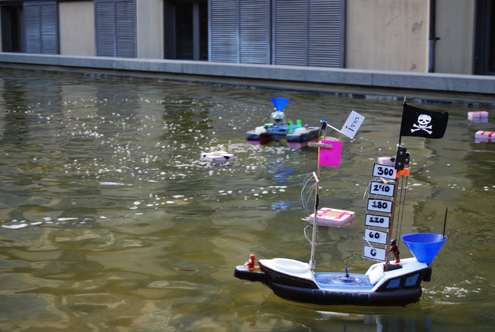
Our team of three created our pirate ship in the Spring of 2010. Our pirate ship was a sleek fiberglass boat that was quickly maneuverable through dangerous waters.
For more details on our pirate ship, check out our project website.
Team: 2 Mechanical Design Engineers and 2 Business Analysts
My Role: Mechanical Design Engineer
Overview
From March 2010 to June 2010 as part of Stanford d.school‘s prestigious Entrepreneurial Design for Extreme Affordability class, I worked with a diverse team of four, including Engineers and MBAs, to help rural Indonesian farmers earn fast cash from the weeds in their farms and simultaneously minimize deforestation.
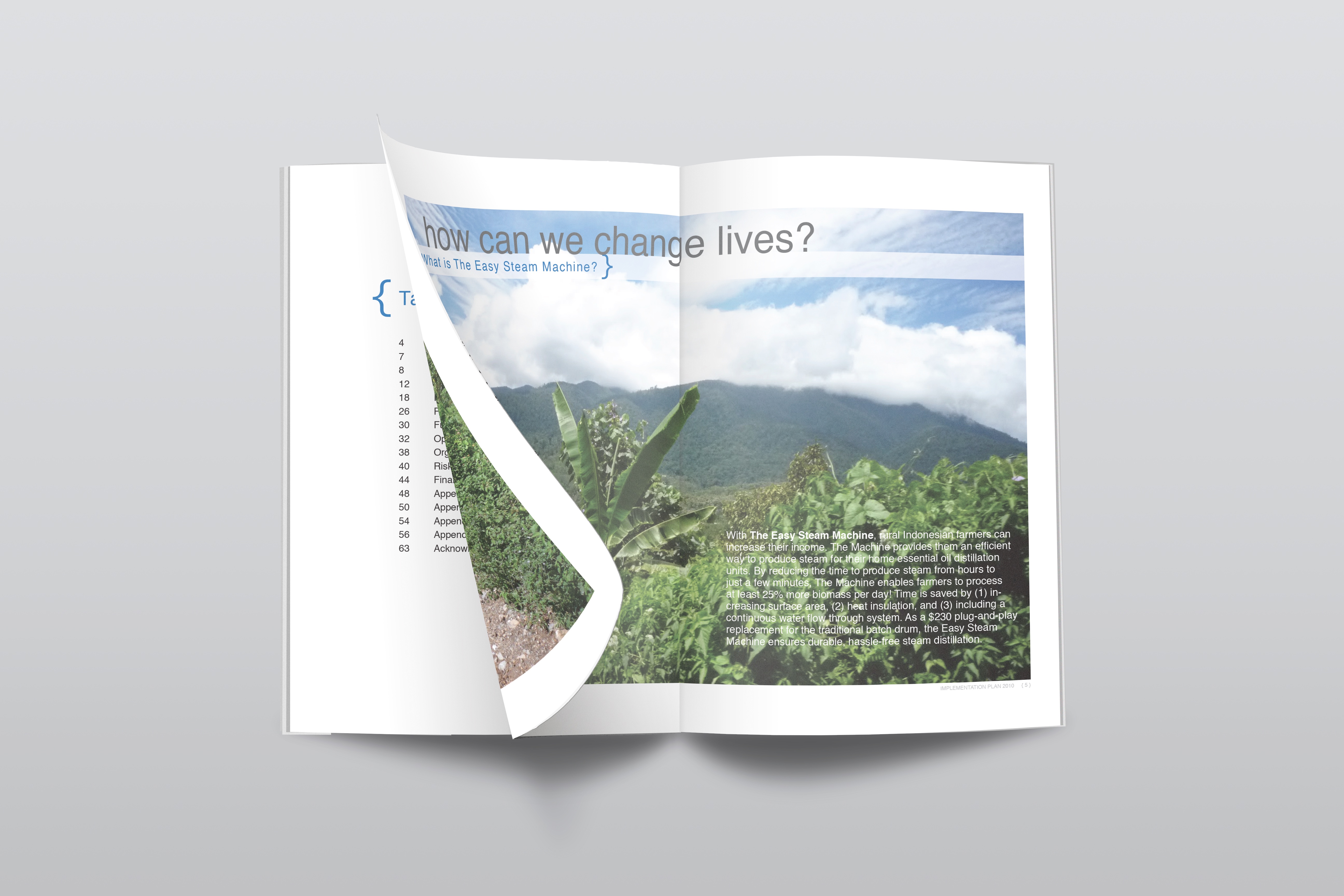
With The Easy Steam Machine, rural Indonesian farmers can increase their income. The Machine provides them an efficient way to produce steam for their home essential oil distillation units. By reducing the time to produce steam from hours to just a few minutes, The Machine enables farmers to process at least 25% more biomass per day! Time is saved by (1) increasing surface area, (2) heat insulation, and (3) including a continuous water flow through system. As a $230 plug-and-play replacement for the traditional batch drum, the Easy Steam Machine ensures durable, hassle-free steam distillation.
The Easy Steam Machine speeds up the weak link in an existing system by two orders of magnitude. Using our boiler technology, we were able to reduce distillation time from 3 hours to 3 minutes!
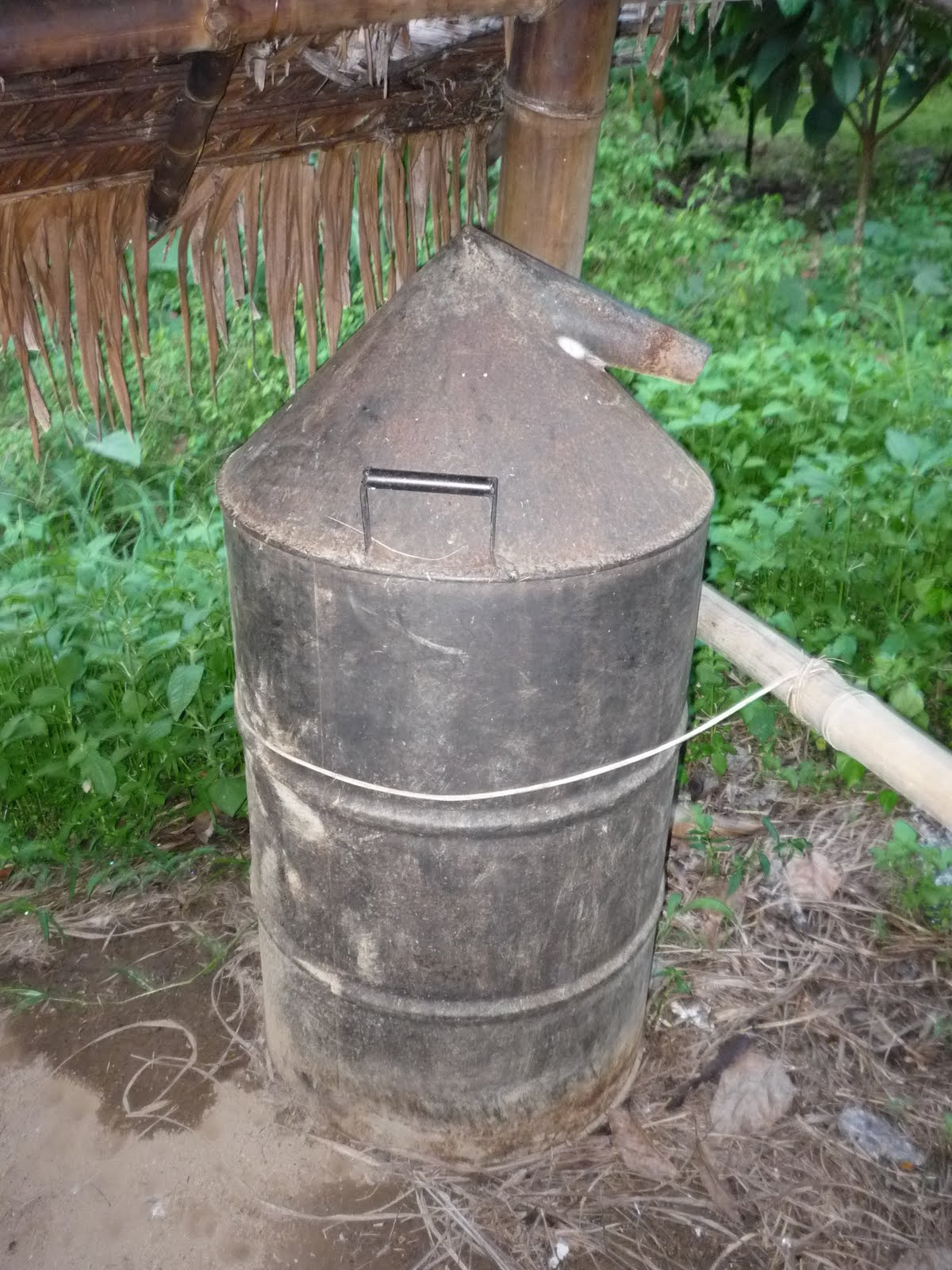
Traditional Batch Drum Distiller
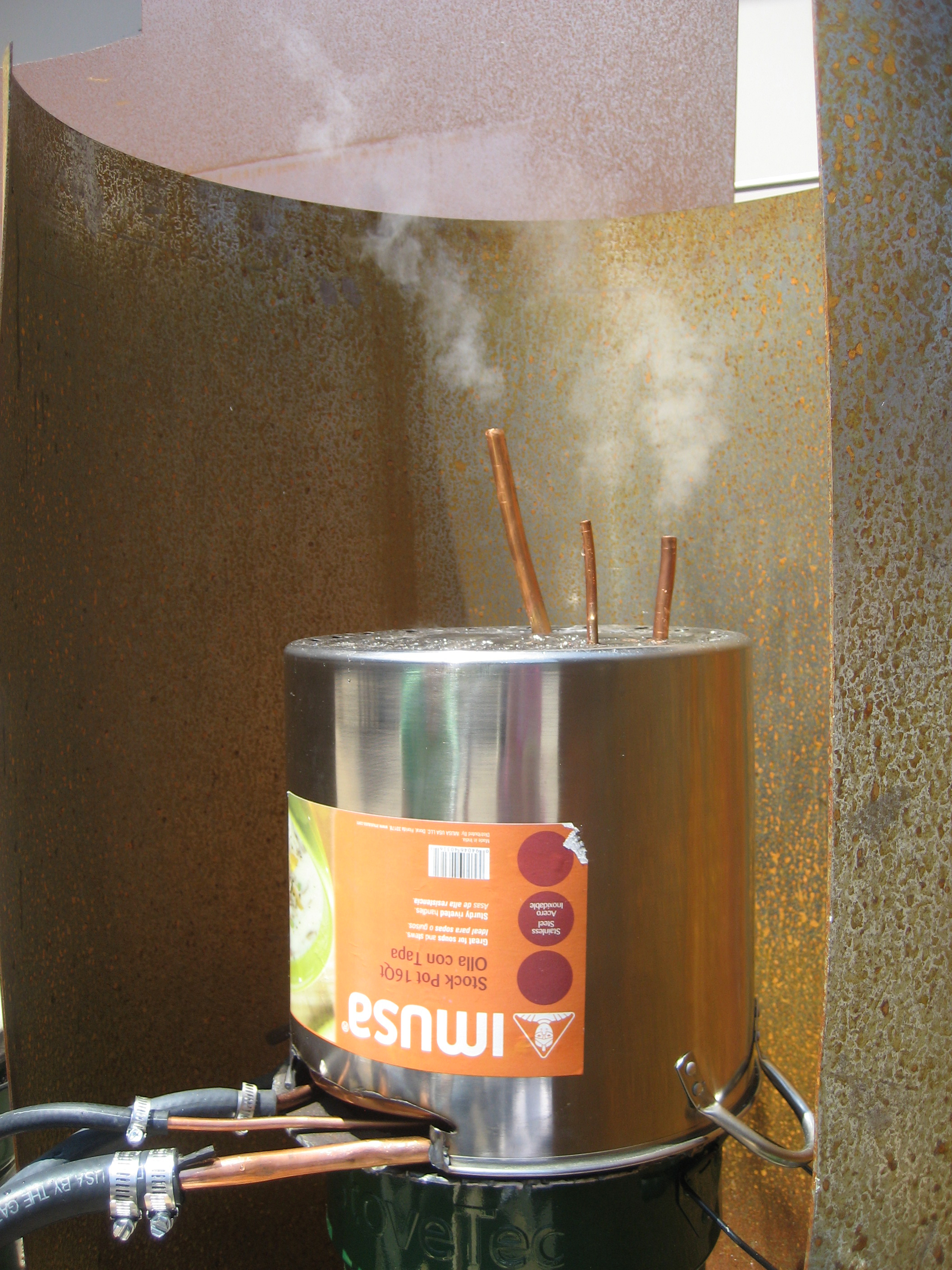
The Easy Steam Machine
The Opportunity
We worked with IBEKA, our NGO partner in Indonesia, to identify the core need of these farmers. For one week, two of my teammates visited, observed, and interviewed these farmers in their fields. We noticed that these farmers were battling with lemongrass as a weed in their farms, and as a result, expanding into fresh rainforests as they struggled to keep their farms going so they could support their families.
Interestingly, most farmers had systems in place to convert their lemongrass into crude lemongrass oil, which they could easily sell for fast cash. However, these distillation systems were left unused, because it took them three hours of valuable time to boil the water necessary to begin the distillation process.
Need Statement
Subsistence farmers in Indonesia need a way to process all of their lemongrass and patchouli into higher value essential oil. Currently, farmers leave up to twenty-five and seventy-five percent of their plant material unprocessed because their essential oil distillation device is too cumbersome and time-intensive. Given the short harvest period and the low throughput of their device, farmers must leave potential income in the field, unprocessed.
The Solution
In order to increase the quantity of oil output, we focused on increasing both the throughput and the yield, i.e. doing a faster job and doing a better job. The Easy Steam Machine is a replacement, plug-and-play device that fits directly into the traditional system — which makes it less expensive than purchasing an entirely new device. It also lowers the barriers to adoption because farmers will feel familiar with the design and user interface.
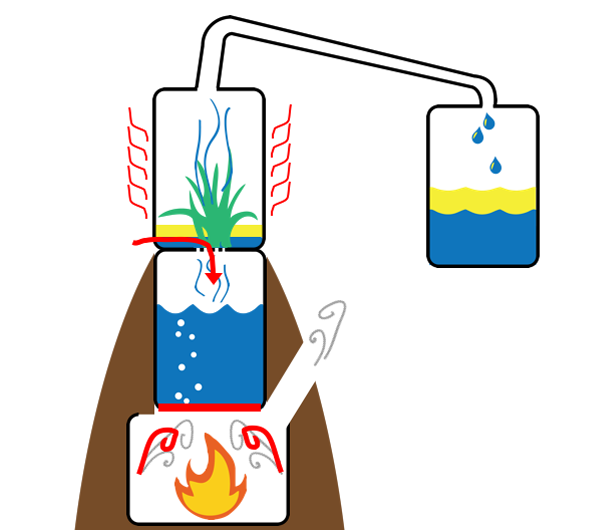
Inefficiencies with Traditional Distillation
The Easy Steam Machine
There are four problems with the existing system that lower throughput and yield: stifled fire, biomass heat loss, poor water-to-fire interface, and high water maintenance. We address each of these with our system by designing a more efficient fire, biomass insulation, higher surface area, and water flow-through.
The Easy Steam Machine speeds up the weak link in an existing system by two orders of magnitude. Using our boiler technology, we were able to reduce distillation time from 3 hours to 3 minutes!
Check out a prototype in action:
Implementation Proposal Plan
Status
We handed this project over to our partner IBEKA to execute and distribute this among their served communities.
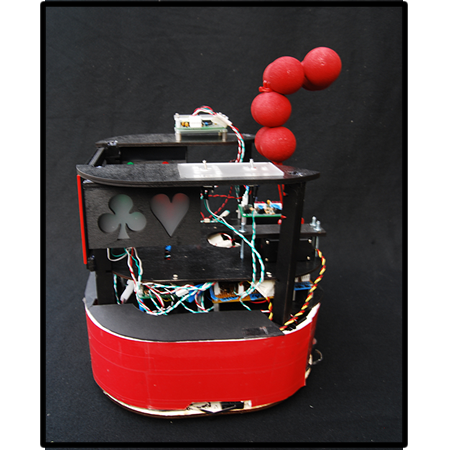
Our team of four created Alice in the Winter of 2010. Alice is a fully autonomous, wall following, PID controlled robot that can knock off targets as specified by a radio-controlled Target Commander device.
Team: 3 Mechatronics Engineers responsible for Mechanical Engineering, Electrical Engineering, Firmware Software Engineering, and Systems Integration
My Role: Mechatronics Engineer with additional focus on Firmware Software Engineering and Systems Integration
The Challenge
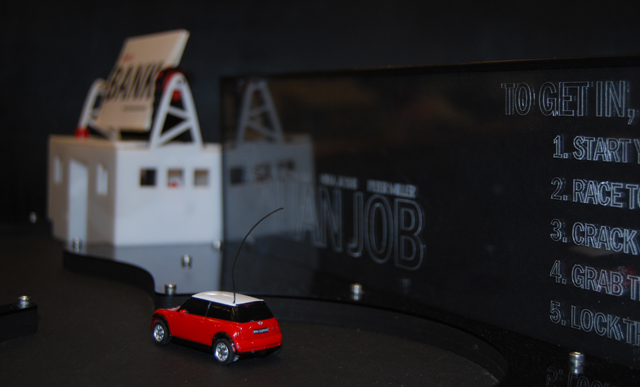
In eighteen days and with an impossible budget of $150 USD, create a full-functioning, robust, interactive, electro-mechanical portrayal of a scene or image from pop-culture.
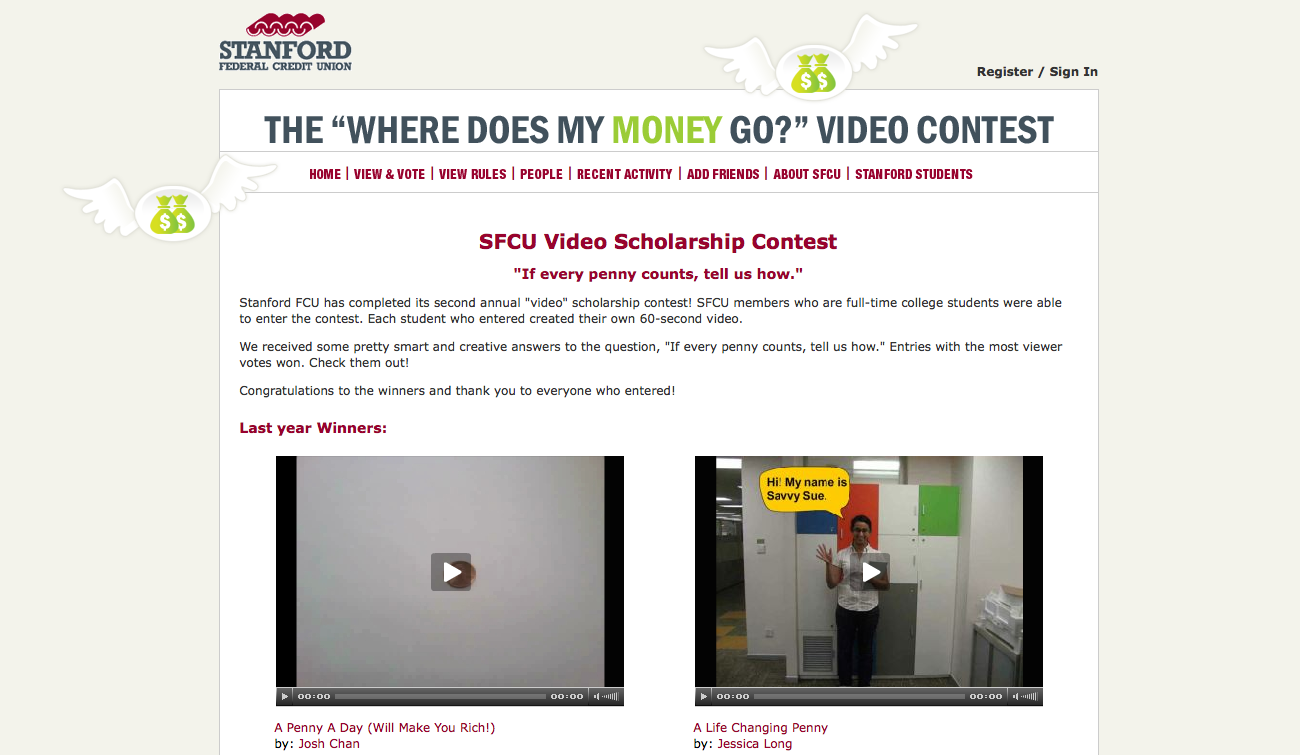
Create a 60-second video to creatively answer the question: “If every penny counts, tell us how.”
We Won!
Within three days my partner and I wrote, filmed, edited, and submitted A Life Changing Penny! We were living in Beijing at the time, and faced the additional fun challenge of filming in a foreign country with limited resources. We had a blast pulling together this stop motion video, and were fortunate enough to win 1st Place in the competition!
Team: Research team of 2 Psychologists and 2 User Experience Designers and Researchers
My Role: User Experience Designer and Researcher
Overview
In the Summer of 2009, I moved to Beijing, China to work for Microsoft Research Asia (MSRA) as a User Experience Design Researcher. I worked on a team of two Psychologists and two User Experience Designers/Researchers.
My time at MSRA was divided into two primary projects: Cross-Cultural Design Research and designing an Enterprise Social Networking Platform.
Cross-Cultural Design Research
With our design research, we strove to understand how to design better digital experiences for a Chinese audience. Using qualitative and quantitative research methodologies and usability studies, we honed in on elements that resonated with our target audience. Specifically, we conducted market research and competitive analysis, surveys, interviews, A/B testing, card sorting, walkthroughs, task analysis, facilitated brainstorming, and participatory design.
We conducted much of our research with our Enterprise Social Networking Platform, the Twinkle Project, which in turn informed our design choices and directed our next iterations.
Enterprise Social Networking Platform
Social networks are a fantastic way to generate and share knowledge among large groups of people. Social software has the potential to build and maintain strong communication and collaboration channels. Yet, why do enterprise social software solutions still leave something to be desired?
There is a huge opportunity to apply social software within the Enterprise. The Twinkle Project explores exactly that. Could we redesign and reinvigorate Social Enterprise Software? How can we enable users to connect, collaborate, share content, knowledge, and expertise, manage information, and increase productivity across an enterprise?
As a designer for Twinkle, I was responsible for design research and strategy and UX and UI design.
During my time at BMW, I was responsible for Cross-Cultural Design Research and the Design and Research for the Head Up Display, Dashboard, and Center Console On-Board Computer.
Cross-Cultural Design Research
Our goal was to understand how aging societies and growing city size might affect our automotive infotainment design both within Germany and abroad. I researched and analyzed demographic data on aging societies, megacities, and their implication on the automobile and drivers. I also researched the latest findings on augmented reality and how we could apply them to the driver experience.
As the sole Design Strategist, I led the team through Design Thinking workshops and facilitated brainstorming sessions.
Head Up Display, Dashboard, and Center Console
Using our cross-cultural design research as a foundation, we designed innovative interactions, UX, and UI for the Head Up Display, Dashboard, and Cluster Instrument Panel (entertainment and driver assistance functionalities). By conducting quantitative research and usability studies, our designs iteratively improved to achieve our priorities. Specifically, we conducted market research and competitive analysis, card sorting, walkthroughs, task analysis, and eye-tracking with 360 degree dynamic and static driving simulators.
Abstract: The importance of spatial and geo-based information has increased over the last few years. The most prevalent example of this kind of information is points of interest (POI) like hotels, restaurants, gas stations, etc. As cars are made for individual transportation, interacting with geo-based information via the In-vehicle Information System (IVIS) should be possible. At present, state-of-the-art IVIS only permit a list based or center based selection on the map, which makes it difficult to handle a high closeness of geo-based data. In this paper, we present alternative approaches for selecting geo-based data with a multifunctional controller. In our work, visual cues help users predict the selection order. An explorative user study showed potential advantages of our concepts.
Team: 2 User Experience Designer/Researchers, 2 Developers
My Role: User Experience Designer and Researcher
Overview
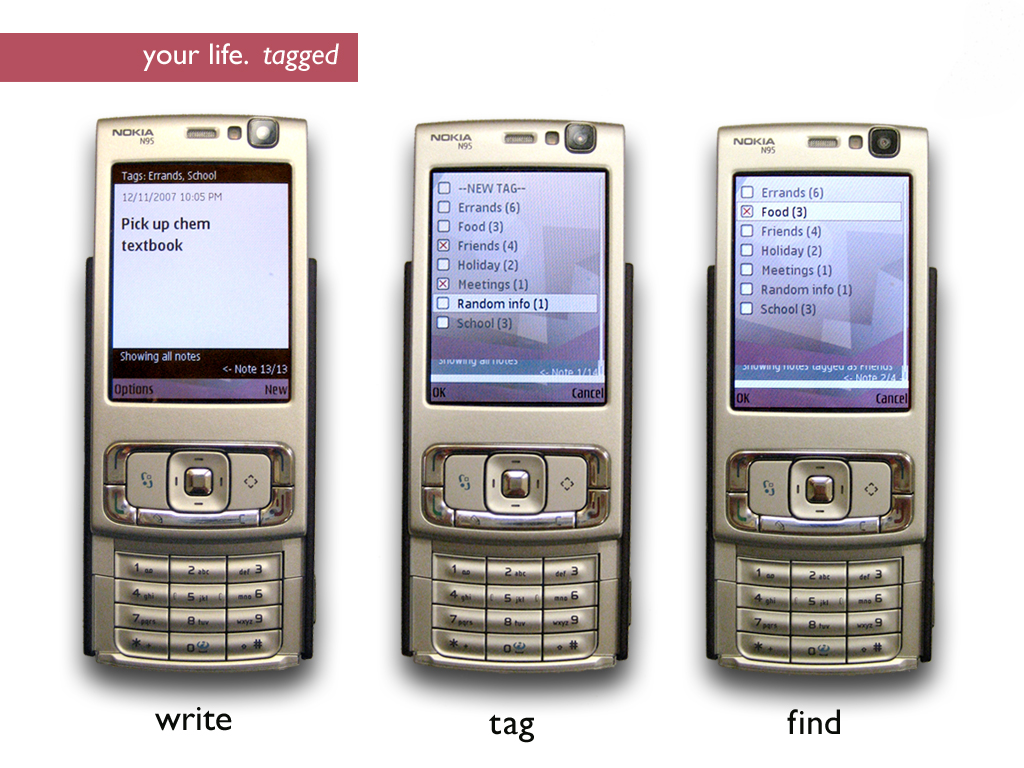
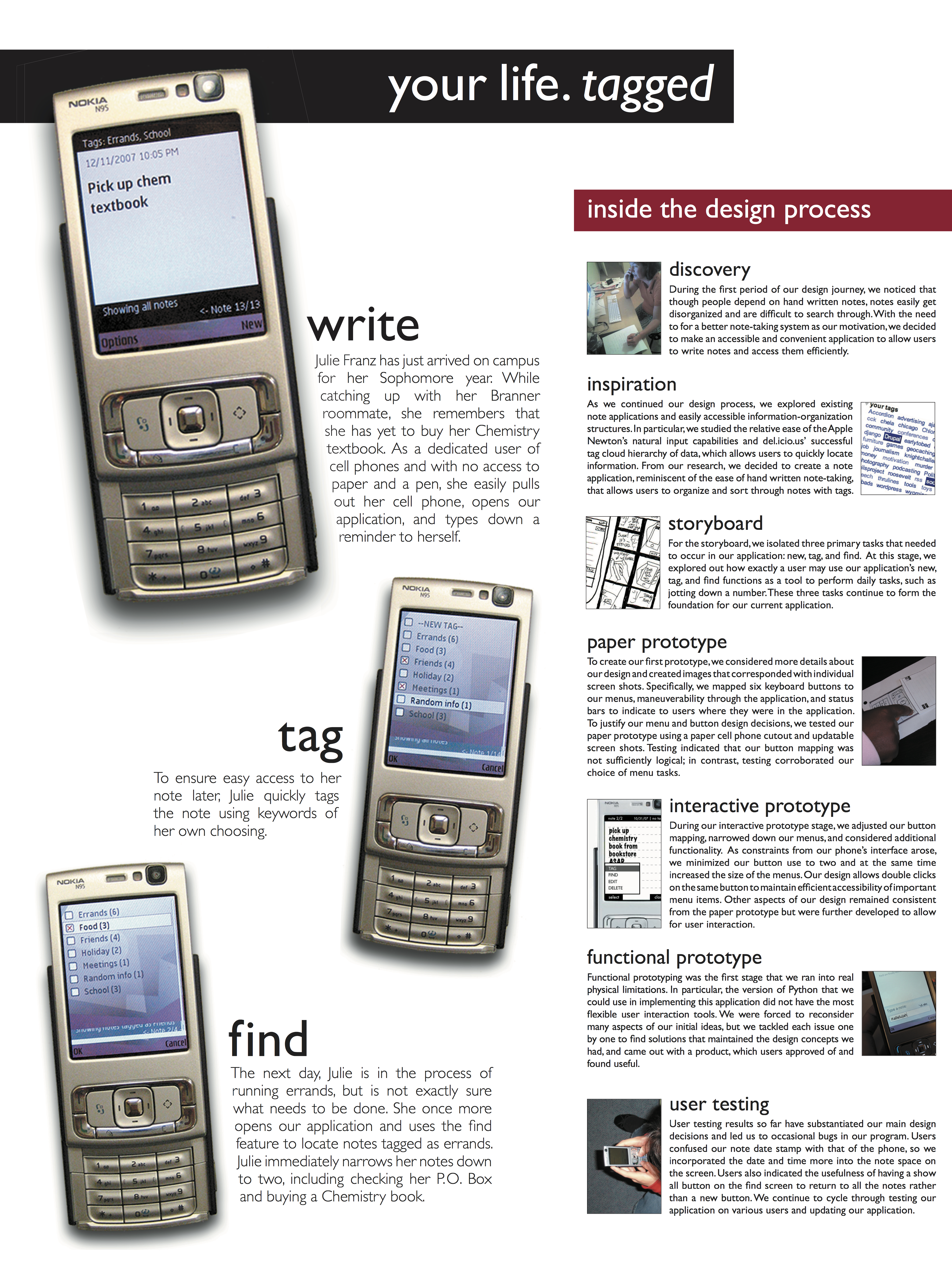
From October 2007 to December 2007, our team of four developed a note taking and note tagging smart phone app in Python that allows users to easily and quickly write, tag, and find notes on a Nokia N95 cell phone.
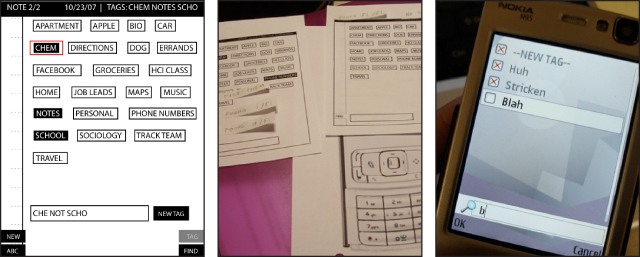
We used paper and functional prototypes to test our concept with users before developing and deploying the app in Python, which we of course tested with more users.